Khut Akhet · Timișoara, România Khut Akhet · Timișoara, Romania
KHA EM AKHET
Răsărind la Orizont Rising at the Horizon
↓ Coboară↓ Scroll
I · Despre Cameră I · About the Lodge
Camera Rituală Khut Akhet lucrează în Ritul Antic și Primitiv de Memphis-Misraïm, un rit sub obediența Marii Loji Naționale din România. Camera Rituală Khut Akhet works in the Ancient and Primitive Rite of Memphis-Misraïm, a Rite under the obedience of the Grand National Lodge of Romania.
Ritul în care lucrăm este o tradiție inițiatică care unește masoneria simbolică a celor trei grade (Ucenic, Calfă, Maestru) cu o arhitectură ezoterică ce se ridică, treaptă cu treaptă, până la cele mai înalte grade ale gândirii hermetice, cabalistice și alchimice. The Rite we follow is an initiatic tradition that joins the symbolic Freemasonry of the three Craft degrees (Apprentice, Fellowcraft, Master) with an esoteric architecture that ascends, step by step, to the highest degrees of Hermetic, Kabbalistic and Alchemical thought.
Camera noastră se înscrie în această linie, păstrând atât autenticitatea filiației egiptene cât și legătura cu masoneria regulară din țară. Our Lodge stands in this lineage, preserving both the authenticity of the Egyptian filiation and the link with the regular Freemasonry of our country.
Camera Rituală Khut Akhet
Timișoara
↓
Ritul Antic și Primitiv
The Ancient and Primitive Rite
de Memphis-Misraïm
of Memphis-Misraïm
↓
Marea Lojă Națională din România (MLNR)
The Grand National Lodge of Romania (MLNR)
mlnr.ro
II · Numele II · The Name
Numele Camerei noastre poartă în sine o taină pe care doar inițiatul o poate desluși: Khut și Akhet sunt, în adevăr, același cuvânt egiptean rostit în două epoci diferite ale istoriei. The name of our Lodge carries within it a mystery only the initiate may decipher: Khut and Akhet are, in truth, the same Egyptian word spoken in two different epochs of history.
Sensul originar al cuvântului, dincolo de simpla traducere prin „orizont", este mult mai profund: locul unde se ridică marea Lumină. The original meaning of the word, beyond the simple translation as "horizon", is far deeper: the place where the great Light rises.
Forma veche a cuvântului, așa cum apare în lucrările primilor egiptologi ai secolului al XIX-lea — secol în care Ritul de Memphis și cel de Misraïm aveau să fie unificate la Napoli (1881) sub Marele Hierofant fratele Garibaldi. The older form of the word, as it appears in the works of the first 19th-century Egyptologists — the very century in which the Memphis and Misraïm Rites were unified in Naples (1881) under the Grand Hierophant Brother Garibaldi.
Forma adoptată de egiptologia contemporană, fixată după convențiile moderne ale transliterării hieroglifelor. The form adopted by contemporary Egyptology, fixed according to modern conventions for the transliteration of hieroglyphs.
Hieroglifa Akhet The Akhet Hieroglyph
Hieroglifa Akhet înfățișează discul solar răsărind între cei doi munți ai orizontului, locul cosmic al transformării și pragul dintre lumea văzută și cea nevăzută. The Akhet hieroglyph depicts the solar disc rising between the two mountains of the horizon — the cosmic place of transformation and the threshold between the visible and the unseen world.
Cei doi munți gemeni sunt Bakhu, muntele răsăritului, și Manu, muntele apusului. Pe ei se sprijină cerul însuși, iar între ei se desfășoară întregul drum al soarelui. The two twin mountains are Bakhu, the mountain of sunrise, and Manu, the mountain of sunset. Heaven itself rests upon them, and between them unfolds the entire path of the sun.
Pragul orizontului era păzit de Aker, zeul-leu cu două capete, întruchipat ca doi lei așezați spate în spate, numiți Sef (Ieri) și Duau (Mâine) — păzitorul care privește simultan spre tot ce a fost și tot ce va fi. The threshold of the horizon was guarded by Aker, the two-headed lion-god, depicted as two lions seated back to back, named Sef (Yesterday) and Duau (Tomorrow) — the guardian who gazes simultaneously upon all that has been and all that will be.
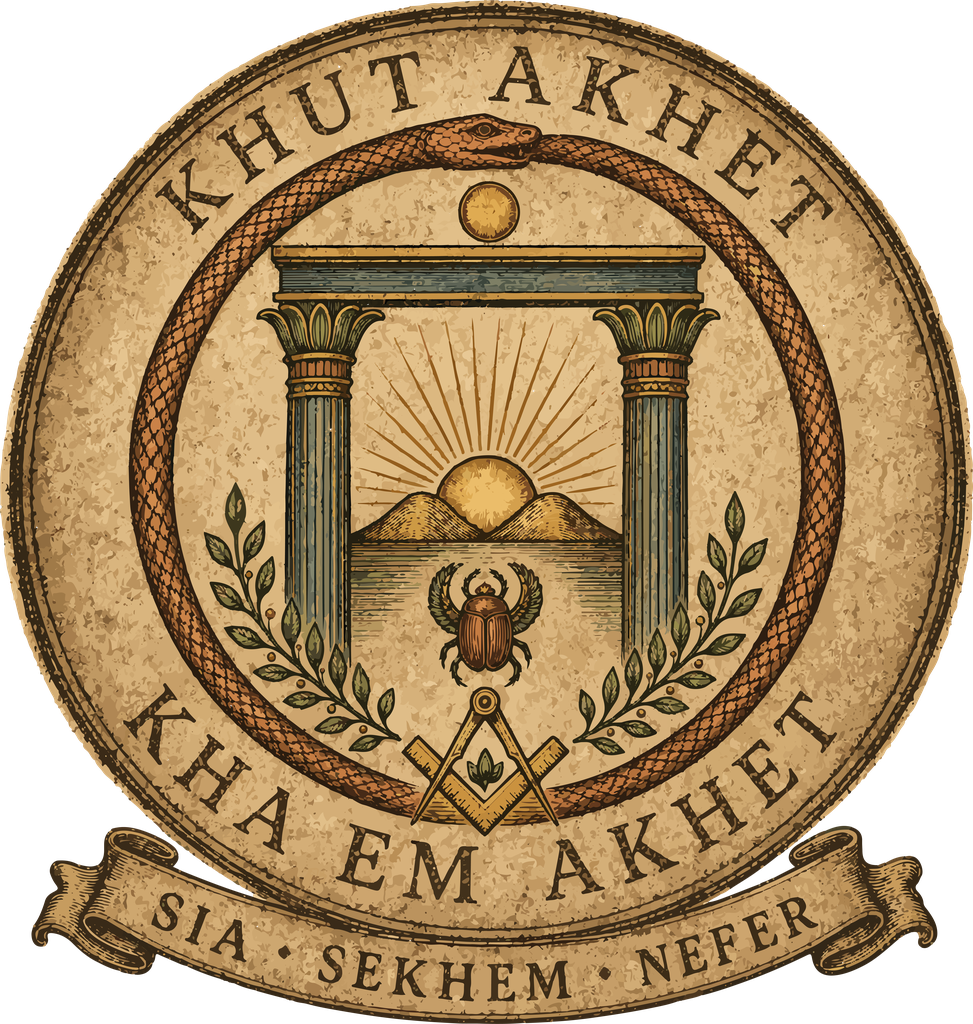
În inima sigiliului nostru, hieroglifa Akhet mărturisește că lucrarea Camerei se face tocmai aici, la pragul răsăritului interior — acolo unde Soarele cunoașterii își începe drumul în fiecare frate. At the heart of our seal, the Akhet hieroglyph testifies that the work of the Lodge takes place precisely here, at the threshold of the inner sunrise — where the Sun of knowledge begins its course in each Brother.
De ce această dublă formă Why this double form
Khut Akhet este, în esență, chemarea aceluiași Adevăr prin două voci ale timpului. Este vechiul și noul rostind împreună același cuvânt sacru. Tradiția neîntreruptă a Ritului care se transmite din generație în generație, păstrându-și esența și reînnoindu-și forma. Khut Akhet is, in essence, the calling of the same Truth through two voices of time. It is the old and the new uttering together the same sacred word — the unbroken tradition of the Rite, transmitted from generation to generation, keeping its essence and renewing its form.
Aceeași hieroglifă, rostită diferit de fiecare epocă: Lumina Ritului rămâne una și aceeași, însă fiecare generație de frați o redescoperă și o rostește în limbajul vremii sale. The same hieroglyph, pronounced differently by each epoch: the Light of the Rite remains one and the same, yet each generation of Brothers rediscovers and pronounces it in the language of their time.
Numele Khut Akhet poartă în sine adevărul renașterii: ceva ce a fost rostit cândva și acum se rostește din nou, ceva ce a strălucit odată și răsare iarăși — orizontul vechi devenit orizont nou. The name Khut Akhet bears within itself the truth of rebirth: something once spoken and now spoken again, something that once shone and rises anew — the old horizon become the new horizon.
Hieroglifa Akhet înfățișează soarele răsărind între doi munți: pragul cosmic dintre lumi, granița sacră dintre întuneric și lumină, dintre profan și sacru, dintre ceea ce a fost și ceea ce va fi. The Akhet hieroglyph depicts the sun rising between two hills: the cosmic threshold between worlds, the sacred boundary between darkness and light, between the profane and the sacred, between what has been and what will be.
III · Deviza III · The Motto
„Răsărind la Orizont" — formula sacră prin care imnurile solare ale Egiptului antic descriau apariția soarelui la pragul lumii, în zorii fiecărei zile. "Rising at the Horizon" — the sacred formula by which the solar hymns of ancient Egypt described the appearance of the sun at the threshold of the world at every dawn. · Imnurile solare egiptene · Egyptian solar hymns
Unul dintre cele mai vechi cuvinte egiptene, scris cu hieroglifa Soarelui Răsărind. Înseamnă „a se ridica, a se manifesta în splendoare" și era folosit deopotrivă pentru răsăritul soarelui și pentru încoronarea faraonului. Pentru egipteni, același act sacru: o ființă luminoasă care se ridică spre vederea lumii. One of the most ancient Egyptian words, written with the hieroglyph of the Rising Sun. It means "to rise, to manifest in splendour" and was used both for the rising of the sun and for the coronation of the pharaoh. For the Egyptians, the same sacred act: a luminous being rising into the sight of the world.
Em Akhet așază această manifestare exact la prag, la orizontul cosmic dintre întuneric și lumină, dintre nevăzut și văzut. Este locul în care Soarele își „ridică" prima rază peste ceea ce a fost noapte. "Em Akhet" places this manifestation exactly at the threshold — at the cosmic horizon between darkness and light, between the unseen and the seen. It is the place where the Sun "lifts" its first ray over what has been night.
În tradiția Camerei, „Kha em Akhet" nu este doar o invocație astronomică, ci o formulă inițiatică: fiecare frate este chemat să răsară, să se ridice din întunericul propriu către lumina pe care o caută. In the tradition of the Lodge, "Kha em Akhet" is not merely an astronomical invocation but an initiatic formula: every Brother is called to rise, to ascend from his own darkness toward the light he seeks.
Lucrarea masonică este, în această lectură, drumul soarelui în interiorul fiecăruia: Nașterea în Lumină, Coborârea în adâncul Sinelui și Moartea profanului. Masonic work, in this reading, is the journey of the sun within each of us: the Birth into Light, the Descent into the depths of the Self, and the Death of the profane.
IV · Originile IV · Origins
Ritul Antic și Primitiv de Memphis-Misraïm s-a născut din unirea a două tradiții ezoterice frățești: Ritul de Misraïm, originar din Italia, și Ritul de Memphis, născut în Franța. Amândouă pretindeau o filiație ce mergea înapoi până la Misterele egiptene. The Ancient and Primitive Rite of Memphis-Misraïm was born from the union of two fraternal esoteric traditions: the Rite of Misraïm, originating in Italy, and the Rite of Memphis, born in France. Both claimed a lineage reaching back to the Egyptian Mysteries.
Veneția / Italia, sfârșitul secolului al XVIII-lea · Franța, 1814 Venice / Italy, late 18th century · France, 1814
Cuvântul „Misraïm" trimite la denumirea ebraică biblică a Egiptului. Ritul de Misraïm este asociat cu tradițiile masonice egiptene apărute în nordul Italiei la sfârșitul secolului al XVIII-lea, fiind legat în literatura tradițională de Veneția și de anul 1788. The word "Misraïm" refers to the biblical Hebrew name for Egypt. The Rite of Misraïm is associated with the Egyptian Masonic traditions that emerged in northern Italy at the end of the 18th century, traditionally linked to Venice and the year 1788.
În 1814–1815, ritul este introdus în Franța de frații Bédarride, unde se dezvoltă ca sistem inițiatic de inspirație egipteană și hermetică, structurat în 90 de grade. In 1814–1815 the Rite was introduced into France by the Bédarride brothers, where it developed as an initiatic system of Egyptian and Hermetic inspiration, structured in 90 degrees.
Montauban, 1814/1815 · Jacques-Étienne Marconis, 1838 Montauban, 1814/1815 · Jacques-Étienne Marconis, 1838
Numele „Memphis" trimite la vechea capitală a Egiptului de Jos. Originile timpurii ale ritului sunt legate de Montauban, în jurul anilor 1814–1815, prin cercul „Discipolilor din Memphis", asociat cu Samuel Honis, Gabriel-Mathieu Marconis de Nègre și alți fondatori. The name "Memphis" recalls the ancient capital of Lower Egypt. The Rite's earliest origins are linked to Montauban around 1814–1815, through the circle of the "Disciples of Memphis", associated with Samuel Honis, Gabriel-Mathieu Marconis de Nègre, and other founders.
Forma cunoscută a Ritului de Memphis este reorganizată și dezvoltată în 1838 de Jacques-Étienne Marconis de Nègre. Ritul a integrat simbolism egiptean, hermetism, elemente gnostice și cabalistice, fiind structurat în sisteme de grade înalte, adesea până la 92 sau 95 de grade. The known form of the Rite of Memphis was reorganised and developed in 1838 by Jacques-Étienne Marconis de Nègre. The Rite integrated Egyptian symbolism, Hermeticism, Gnostic and Kabbalistic elements, and was structured in systems of high degrees, often reaching 92 or 95 degrees.
V · Unirea V · The Union
În anul 1881, sub autoritatea Marelui Hierofant Giuseppe Garibaldi, cele două tradiții Memphis și Misraïm s-au unit la Napoli într-o familie inițiatică comună, cunoscută ulterior ca Ritul Antic și Primitiv de Memphis-Misraïm. In 1881, under the authority of the Grand Hierophant Giuseppe Garibaldi, the two traditions of Memphis and Misraïm were united in Naples into a common initiatic family, later known as the Ancient and Primitive Rite of Memphis-Misraïm.
Garibaldi, eroul național al Italiei și important lider masonic al secolului al XIX-lea, a fost recunoscut ca Mare Hierofant al riturilor unite. Unificarea din 1881 a adus sub o autoritate comună filiațiile egiptene ale Ritului de Memphis și ale Ritului de Misraïm. Garibaldi, Italy's national hero and a major Masonic leader of the 19th century, was recognised as Grand Hierophant of the united Rites. The 1881 unification brought together, under a single authority, the Egyptian filiations of the Rite of Memphis and the Rite of Misraïm.
Această unire nu a fost o simplă fuziune administrativă: ea a exprimat într-o singură arhitectură inițiatică patrimoniul simbolic egiptean, hermetic, gnostic și cabalistic al celor două rituri. Memphis-Misraïm devenea astfel una dintre cele mai explicite expresii filo-egiptene ale masoneriei de rituri înalte. This union was not a mere administrative merger: it expressed within a single initiatic architecture the Egyptian, Hermetic, Gnostic and Kabbalistic symbolic heritage of the two Rites. Memphis-Misraïm thereby became one of the most explicit philo-Egyptian expressions of the Freemasonry of high Rites.
Tradiția continuă astăzi prin numeroase obediențe și jurisdicții în Europa, America Latină, Statele Unite și Africa de Nord. În România, lucrarea Ritului Antic și Primitiv de Memphis-Misraïm se desfășoară sub recunoașterea Marii Loji Naționale din România. The tradition continues today through numerous obediences and jurisdictions in Europe, Latin America, the United States, and North Africa. In Romania, the work of the Ancient and Primitive Rite of Memphis-Misraïm is conducted under the recognition of the Grand National Lodge of Romania.
Camera Rituală Khut Akhet din Timișoara se înscrie în această lungă filiație, ca o nouă rostire a aceluiași cuvânt egiptean primordial. Camera Rituală Khut Akhet, in Timișoara, stands within this long lineage, as a new utterance of the same primordial Egyptian word.
VI · Structura VI · Structure
Ritul Antic și Primitiv de Memphis-Misraïm este structurat în 95 de grade, organizate în patru serii ascendente. Fiecare serie corespunde unui plan de cunoaștere și unei trepte a lucrării interioare. The Ancient and Primitive Rite of Memphis-Misraïm is structured in 95 degrees, organised into four ascending series. Each series corresponds to a plane of knowledge and a step of inner work.
Cele trei grade ale masoneriei universale: Ucenic, Calfă, Maestru. Aici se așază piatra de temelie a oricărei lucrări inițiatice. În Camera Rituală Khut Akhet, ca în orice lojă regulară, lucrarea începe de la Gradul I. The three degrees of universal Freemasonry: Apprentice, Fellowcraft, Master. Here the cornerstone of all initiatic work is laid. In Camera Rituală Khut Akhet, as in any regular Lodge, the work begins from the First Degree.
O serie ce include și gradele Ritului Scoțian Antic și Acceptat, dar le interpretează prin prisma egipteană și hermetică. Lucrarea trece prin treptele creștine, gnostice și cavalerești ale tradiției ezoterice europene. A series that also includes the degrees of the Ancient and Accepted Scottish Rite but interprets them through the Egyptian and Hermetic lens. The work passes through the Christian, Gnostic and chivalric steps of the European esoteric tradition.
Gradele unice ale familiei Memphis-Misraïm. Aici se adâncesc filosofia hermetică, simbolurile alchimice și treptele Arborelui Cabalistic. Lucrarea cere studiu, contemplație și o anumită maturitate inițiatică. The degrees unique to the Memphis-Misraïm family. Here Hermetic philosophy, alchemical symbols and the steps of the Kabbalistic Tree are deepened. The work demands study, contemplation, and a certain initiatic maturity.
Treapta cea mai înaltă, rezervată unei lucrări de natură pur ezoterică și administrativă a Ritului. Cuprinde Misterele Magice ale lui Memphis și gradele Sanctuarului, culminând cu Gradul 95: Patriarh Mare Conservator. The highest step, reserved for a work of purely esoteric and administrative nature within the Rite. It encompasses the Magical Mysteries of Memphis and the degrees of the Sanctuary, culminating in the 95th: Patriarch Grand Conservator.
VII · Filosofia VII · Philosophy
Spre deosebire de alte rituri masonice, Memphis-Misraïm își întemeiază lucrarea pe patru izvoare ezoterice care, împreună, alcătuiesc o singură arhitectură a cunoașterii. Unlike other Masonic Rites, Memphis-Misraïm grounds its work in four esoteric sources which, together, form a single architecture of knowledge.
Misterele lui Isis, Osiris, Horus și Toth. Templele și piramidele ca diagrame ale sufletului. Cartea Morților ca itinerar al inițiatului. Egiptul este izvorul. The mysteries of Isis, Osiris, Horus and Thoth. Temples and pyramids as diagrams of the soul. The Book of the Dead as the initiate's itinerary. Egypt is the source.
Tradiția lui Hermes Trismegistos, Tabula Smaragdina, Corpus Hermeticum. Principiul „cum este sus, așa este și jos" — cheia oricărei transmutări simbolice. The tradition of Hermes Trismegistus, the Tabula Smaragdina, the Corpus Hermeticum. The principle "as above, so below" — the key to any symbolic transmutation.
Arborele Vieții cu cele zece sefirot. Geometria sacră a urcării — de la Malkhut, regatul materiei, până la Keter, coroana. O hartă a sufletului în călătoria sa de întoarcere. The Tree of Life with its ten Sefirot. The sacred geometry of the ascent — from Malkuth, the kingdom of matter, to Keter, the crown. A map of the soul on its journey of return.
Solve et coagula — dizolvă și recoagulează. Marea Operă a transformării interioare: plumbul prefăcut în aur, omul vechi prefăcut în om nou. Operația perpetuă a fratelui asupra lui însuși. Solve et coagula — dissolve and coagulate. The Great Work of inner transformation: lead turned to gold, the old man turned into the new. The perpetual operation of the Brother upon himself.
VIII · Diferența VIII · Distinction
Toate Riturile masonice împărtășesc cele trei grade de bază. Diferența esențială apare după aceea: în arhitectura înaltă a fiecărui Rit. All Masonic Rites share the three basic degrees. The essential difference appears afterwards: in the high architecture of each Rite.
Construite în jurul unei ramuri preponderent cavalerești și creștine: Templierii, Rosicrucienii, ordinele cruciate. Studiul ezoteric este prezent, dar e încadrat de un imaginar al cetății și al cavaleriei. Built around a predominantly chivalric and Christian branch: the Templars, the Rosicrucians, the crusader orders. Esoteric study is present, but framed by an imagery of citadel and knighthood.
Construit în jurul unei filiații preponderent egiptene și hermetice: Misterele Nilului, hermetismul alexandrin, cabala, alchimia operativă. Templul ia forma unei piramide; cavalerul devine hierofant. Built around a predominantly Egyptian and Hermetic filiation: the Mysteries of the Nile, Alexandrian Hermeticism, Kabbalah, operative alchemy. The temple takes the form of a pyramid; the knight becomes a hierophant.
Memphis-Misraïm nu se opune celorlalte Rituri — el le completează. Este Ritul în care un mason interesat de gândirea Egiptului, de hermetism și de marile căi spirituale orientale găsește o casă structurată, ritualică și autentică. Memphis-Misraïm does not oppose the other Rites — it complements them. It is the Rite in which a Mason drawn to Egyptian thought, to Hermeticism, and to the great Eastern spiritual paths finds a structured, ritual and authentic home.
IX · Simboluri IX · Symbols
În Memphis-Misraïm, fiecare simbol vorbește pe trei niveluri deodată: literal, hermetic și inițiatic. Iată câteva dintre simbolurile centrale ale lucrării noastre. In Memphis-Misraïm, each symbol speaks on three levels at once: literal, Hermetic and initiatic. Here are some of the central symbols of our work.
Crucea egipteană a vieții. Cheia care deschide pragul dintre lumi. The Egyptian cross of life. The key that opens the threshold between worlds.
Conștiința supremă privind prin templu. Vederea unității dincolo de aparențe. The supreme consciousness gazing through the temple. The vision of unity beyond appearances.
Hieroglifa „Kha". Manifestarea luminii la pragul lumii — și a conștiinței la pragul cunoașterii. The "Kha" hieroglyph. The manifestation of light at the threshold of the world — and of consciousness at the threshold of knowing.
Pentagrama înflăcărată — emblema Calfei, semn al omului perfectat. The flaming pentagram — emblem of the Fellowcraft, sign of the perfected man.
Iachin și Boaz. Polii dualității prin care fratele trece pentru a ajunge la unitate. Jachin and Boaz. The poles of duality through which the Brother passes to reach unity.
Cele patru puncte cardinale ale lucrării: răsărit, miază-zi, apus, miază-noapte. The four cardinal points of the work: dawn, noon, dusk, midnight.
X · Astăzi X · Today
Ritul Antic și Primitiv de Memphis-Misraïm continuă astăzi să fie practicat în zeci de țări. Rămâne o tradiție vie — nu o reconstituire muzeală, ci o lucrare care își aduce frații împreună în jurul aceleiași discipline interioare. The Ancient and Primitive Rite of Memphis-Misraïm continues to be practised today in dozens of countries. It remains a living tradition — not a museum reconstitution, but a working that brings its Brothers together around the same inner discipline.
În Camera Rituală Khut Akhet, cele trei grade de bază sunt completate de o atenție constantă pentru studiul textelor egiptene, hermetice și cabalistice. Fiecare lucrare se face cu rigoare ritualică, dar și cu deschidere intelectuală. In Camera Rituală Khut Akhet, the three basic degrees are accompanied by constant attention to the study of Egyptian, Hermetic and Kabbalistic texts. Each working is conducted with ritual rigour, yet with intellectual openness.
Camera nu se ocupă cu politica, religia sau afacerile lumii profane. Lucrarea este pur inițiatică: să facă din omul vechi un om nou, după cuvântul vechi al alchimiștilor. The Lodge does not concern itself with politics, religion, or the affairs of the profane world. The work is purely initiatic: to make of the old man a new man, in the ancient phrase of the alchemists.
Accesul în Cameră se face exclusiv prin recomandare frățească. Nu există recrutare, publicitate sau invitații publice — drumul către Cameră este, prin tradiție, un drum personal. Access to the Lodge is granted exclusively by fraternal recommendation. There is no recruitment, no advertising, and no public invitation — the road to the Lodge is, by tradition, a personal road.
XI · Lecturi XI · Readings
Pentru cititorul curios, câteva lucrări care deschid porțile tradiției Memphis-Misraïm și ale gândirii ei. For the curious reader, a few works that open the gates of the Memphis-Misraïm tradition and its thought.
XII · ContactXII · Contact
Pentru întrebări privind lucrarea Camerei sau tradiția Memphis-Misraïm, ne poți scrie la adresa de mai jos. Răspundem fiecărui mesaj primit. For questions about the Lodge's work or the Memphis-Misraïm tradition, you may write to us at the address below. We reply to every message received.
Sediu Location Timișoara, România
Email Email secretar@khutakhet.ro
Obediență Obedience Marea Lojă Națională din România
Răspundem la fiecare mesaj pe care îl primim, în ordinea sosirii. Te rugăm să fii răbdător dacă răspunsul întârzie câteva zile. We reply to every message we receive, in the order they arrive. Please be patient if a reply takes a few days.